Artificial intelligence is rapidly transforming industries from banking to business services, and Philippine leading integrated telco PLDT Inc. (PLDT) is positioning universities and communities to participate in that shift by expanding the infrastructure and training needed to deploy the technology.
Speaking at a forum marking the 50th anniversary of the Mendiola Consortium at Centro Escolar University in Manila, Blums Pineda, Senior Vice President and Head of Enterprise Business Group at PLDT and Smart, and PLDT Group AI Business Lead, said universities will play a central role in preparing the workforce for an economy increasingly shaped by machine-assisted decision-making.
“Artificial intelligence is not just another technology cycle,” Pineda said. “It’s a general-purpose technology like electricity or the internet—one that changes how entire industries operate and how professionals do their work.”
AI’s impact on the workforce
The shift carries particular weight for the Philippines, whose economy is closely tied to global services and knowledge-based work. Global research shows that roughly 25% to 35% of jobs may be exposed to AI at the level of individual tasks, while only 3% to 5% face a high risk of full displacement.
Instead, the more common outcome is job transformation. That is already visible in the Philippines’ IT-BPM industry, which employs nearly two million workers, where AI supports tasks such as summarizing interactions and retrieving information, allowing workers to focus on more complex and value-driven roles.
“What we’re seeing is not the disappearance of human roles,” Pineda said. “AI handles repetitive tasks, while people focus on decision-making, relationships, and solving more complex problems.”
Universities under pressure to adapt
For universities, the implications go beyond adding new technology courses. Students graduating today will enter a workforce where machines can assist with writing software, analyzing markets, and supporting medical diagnoses.
“Every technological revolution eventually walks into a classroom,” Pineda said. “The difference with AI is that it didn’t politely wait for curriculum committees. It has already arrived.”
The shift is influencing how universities design courses, conduct research, and manage administrative operations, with AI increasingly supporting teaching and analytics. At the same time, institutions are navigating challenges around academic integrity, bias, and responsible AI.

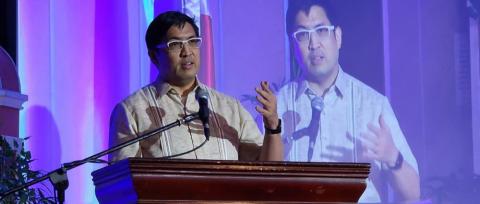
Blums Pineda, SVP and Head of PLDT and Smart Enterprise Business Group and PLDT Group AI Business Lead, speaks to academic leaders of the Mendiola Consortium on the evolving role of AI in education.
In this space, PLDT Enterprise and ePLDT have also been working closely with universities to support early-stage adoption. One example is an ongoing engagement with De La Salle University (DLSU), where the team is exploring the ePLDT SwiftStart AI Program. Designed as an immersive introduction to generative AI, SwiftStart enables institutions to understand foundational concepts such as prompt engineering, while experiencing practical applications using tools like Google Workspace with Gemini.
Building the infrastructure behind AI
For the PLDT Group, the critical enabler of AI adoption lies in infrastructure—particularly high-performance computing, connectivity, and secure data environments.
Through its corporate business arm PLDT Enterprise and subsidiaries ePLDT and VITRO, Inc., which deliver integrated digital, connectivity, and ICT solutions to public and private institutions in the Philippines and abroad, the PLDT Group has been investing in hyperscale data centers capable of supporting AI workloads.
Among them is VITRO Sta. Rosa, the country’s first hyperscale data center designed for AI applications. The facility hosts Pilipinas AI, a sovereign AI solutions stack that allows organizations to run AI workloads while keeping data within Philippine borders.
“The invisible infrastructure behind AI—fiber networks, computing power, and data centers—will determine how quickly institutions can innovate,” Pineda said.
Expanding access to AI
Beyond infrastructure, PLDT and Smart are expanding access to AI through initiatives such as AI-in-a-Box, which provides literacy training, connectivity, and practical tools for institutions. “Technology only transforms society when ordinary institutions can use it,” Pineda said.
Ultimately, preparing students for an AI-driven economy will require not only technical knowledge but also skills that machines cannot easily replicate, including critical thinking, ethical judgment, and interdisciplinary problem-solving.
“The future of AI in education won’t be determined by how quickly we buy new tools,” Pineda said. “It will be determined by how carefully we build the systems behind them.”
The PLDT Group’s efforts support its commitment to inclusive innovation, quality education, and workforce development aligned with the United Nations Sustainable Development Goals.